How to choose a handwriting workbook (and why arrows matter more than pages)
Most handwriting workbook listings sell on page count, as though more pages means more learning. A hundred pages of the wrong starting stroke teaches the wrong starting stroke a hundred times.
Check for a start dot and numbered arrows on every letter
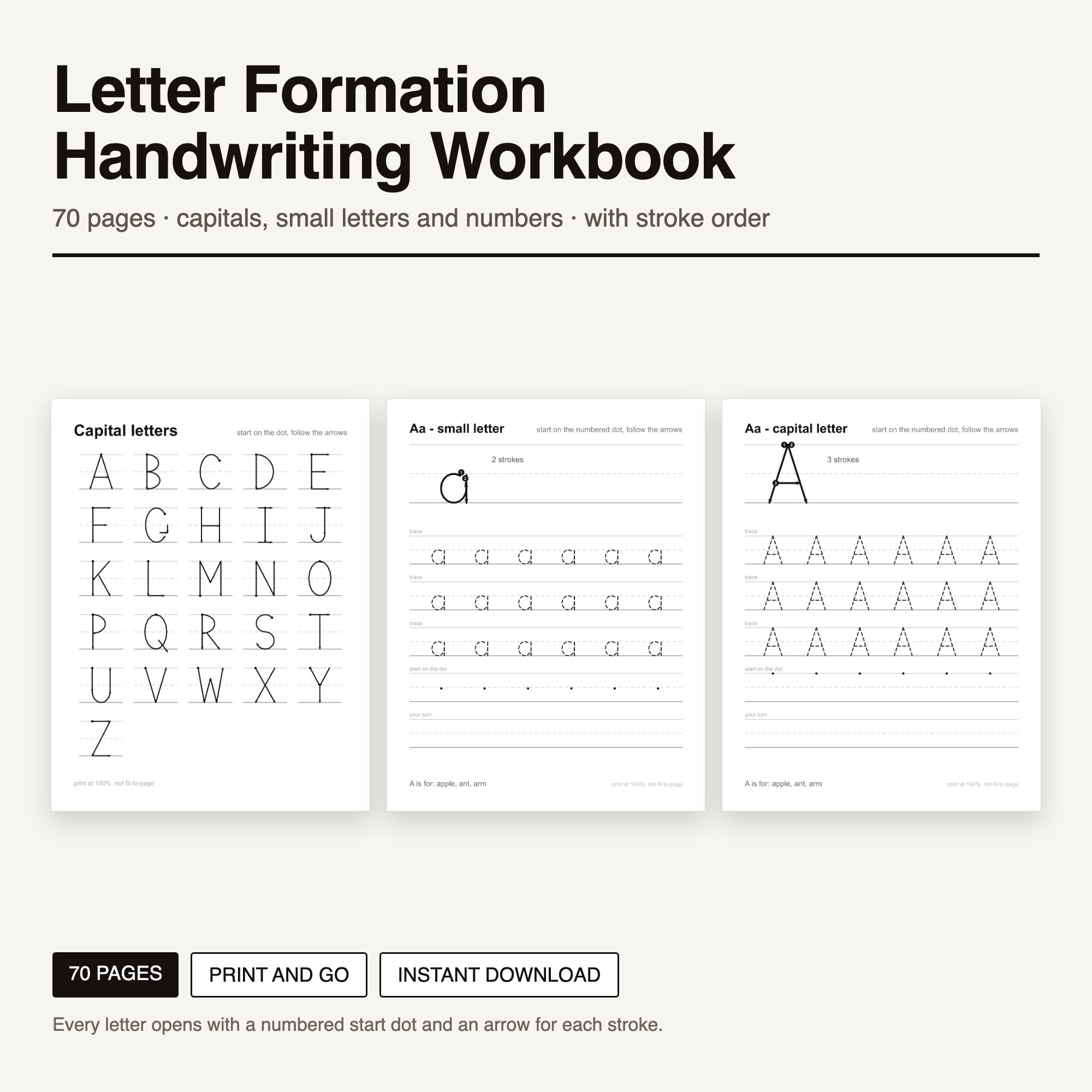
Handwriting is a sequence, not a shape: b and d are the same shape started from different places, which is exactly why they get confused. A workbook worth buying marks where the pencil starts and which direction each stroke travels, on every letter — not just the sample page. Plain outlines with no arrows will reinforce whatever habit is already there.
Line width should match the hand, not the age on the cover
A wide, double-ruled line with a dashed midline suits a child still learning where letters sit; a single ruled line suits a child past that stage. "Ages 4 to 8" on a cover usually means one width was chosen for the whole range, which is too wide a range for the line to actually fit. Judge the sample page against the child in front of you.
Uppercase, lowercase, or both
Some workbooks are uppercase-only because it is easier to form; others go straight to lowercase because that is what school actually uses first. Neither is wrong, but an uppercase-only book for a child being taught lowercase at school is solving the wrong problem.
Tracing versus copying
Tracing over a printed letter builds motor memory but can be done without really looking at where the strokes go. A workbook that also asks the child to copy the letter into a blank space, once tracing is established, tests whether the shape has actually transferred.
What we make, plainly labelled
Our own letter formation workbook is ours, and it follows the first rule above directly: every lowercase letter carries a numbered stroke-order arrow and a start dot, because that is the change that fixes most reversals faster than repetition does. It does not fix grip or pencil pressure — that is a hand-strength problem, not a page-layout one, and no workbook fixes it on its own.
Questions people ask
Does more repetition fix letter reversals?
Usually not on its own. Reversals are almost always about where the stroke starts, and repeating the wrong start just practices the wrong start. Arrows marking the start are what changes it.
Should a workbook match the child's exact age?
Match it to the child's current hand and current letters, not the age band on the cover. Two five-year-olds can need entirely different books.
Is a workbook enough on its own?
For most children, yes, for the writing-specific part. A child who also struggles with grip or hand strength usually needs non-writing hand-strength activities alongside it.
More like this
What makes a good printable reading logWhat to look for in a preschool scissor-skills packPart of our guide to Buying guides: for a specific child.