When a child still writes b and d backwards
It looks like a red flag and it usually is not. Letter reversals are ordinary in children up to around seven, and more practice is rarely what resolves them.
Why it happens
Everything else a child has ever learned is the same object when it faces the other way. A cup is a cup rotated; a dog is a dog facing left. Letters are the first thing in a child's life where direction changes identity, and that is a genuinely new idea.
Fix the starting point, not the letter
Most reversals come from starting the letter in the wrong place. Both b and d begin differently and that beginning decides the rest: b starts with the tall line, then the belly. d starts with the circle, then the line.
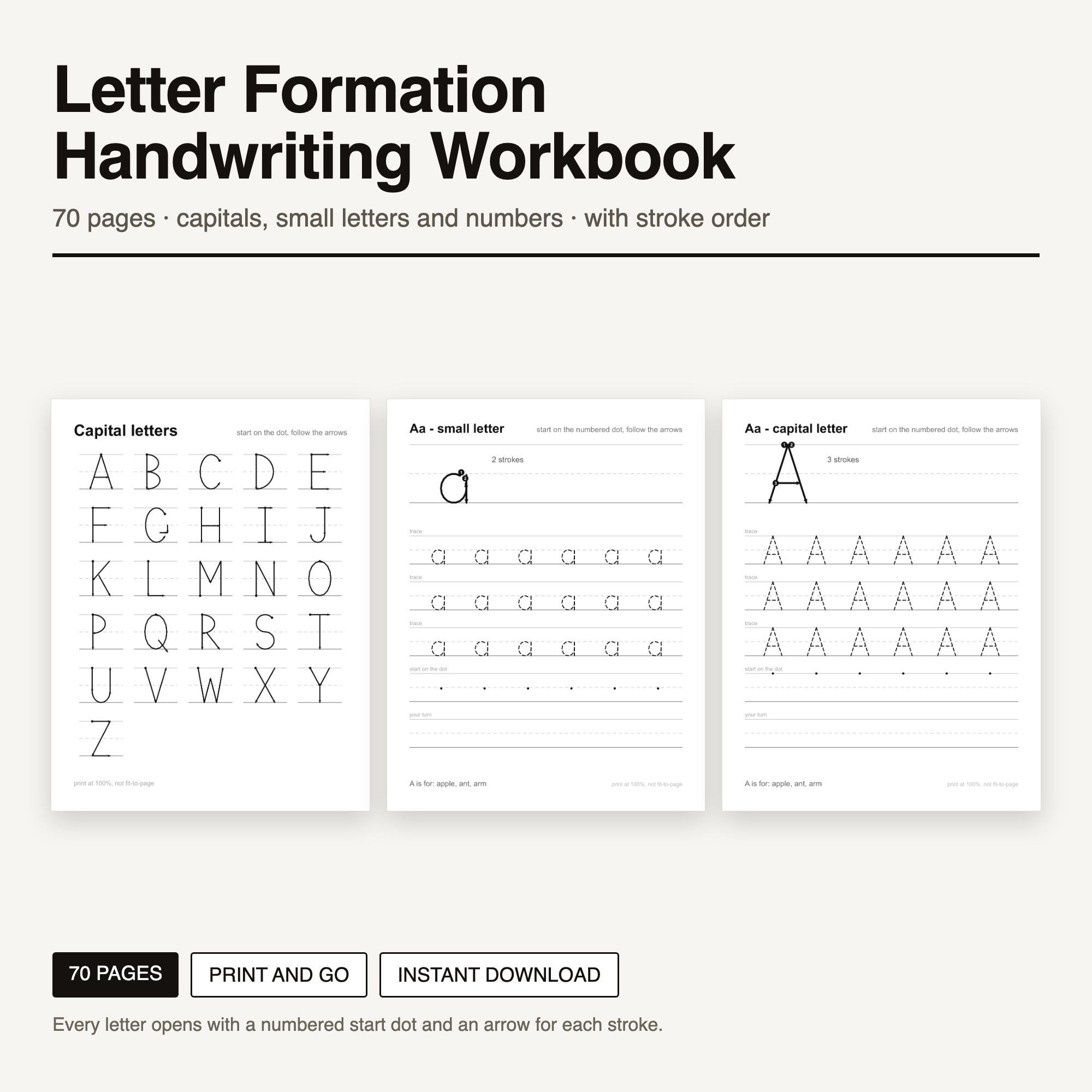
This is why arrows on the letter help when plain tracing does not — the arrow corrects the start, and everything downstream follows.
When it is worth asking someone
Reversals persisting well past seven, or alongside difficulty hearing the sounds in a spoken word, are worth raising with the teacher. We are not qualified to diagnose anything and would not try — but "worth mentioning at parents' evening" is a reasonable bar.
Questions people ask
Is writing letters backwards a sign of dyslexia?
Not on its own. Reversals are common in typical readers and writers up to about seven. Persisting reversals combined with difficulty hearing sounds within words is the pattern worth asking a teacher or specialist about — and that is a question for them, not for us.
Should I correct it every time?
No. Correct the starting point at practice time, and let ordinary writing be ordinary writing. Constant correction usually produces a child who writes less.
Do letter-reversal worksheets work?
Only if they change where the pencil starts. A sheet that just asks for more repetitions reinforces whatever habit is already there.
More like this
Handwriting for a left-handed childWhen a child grips the pencil so hard their hand hurtsPart of our guide to Handwriting & early skills.