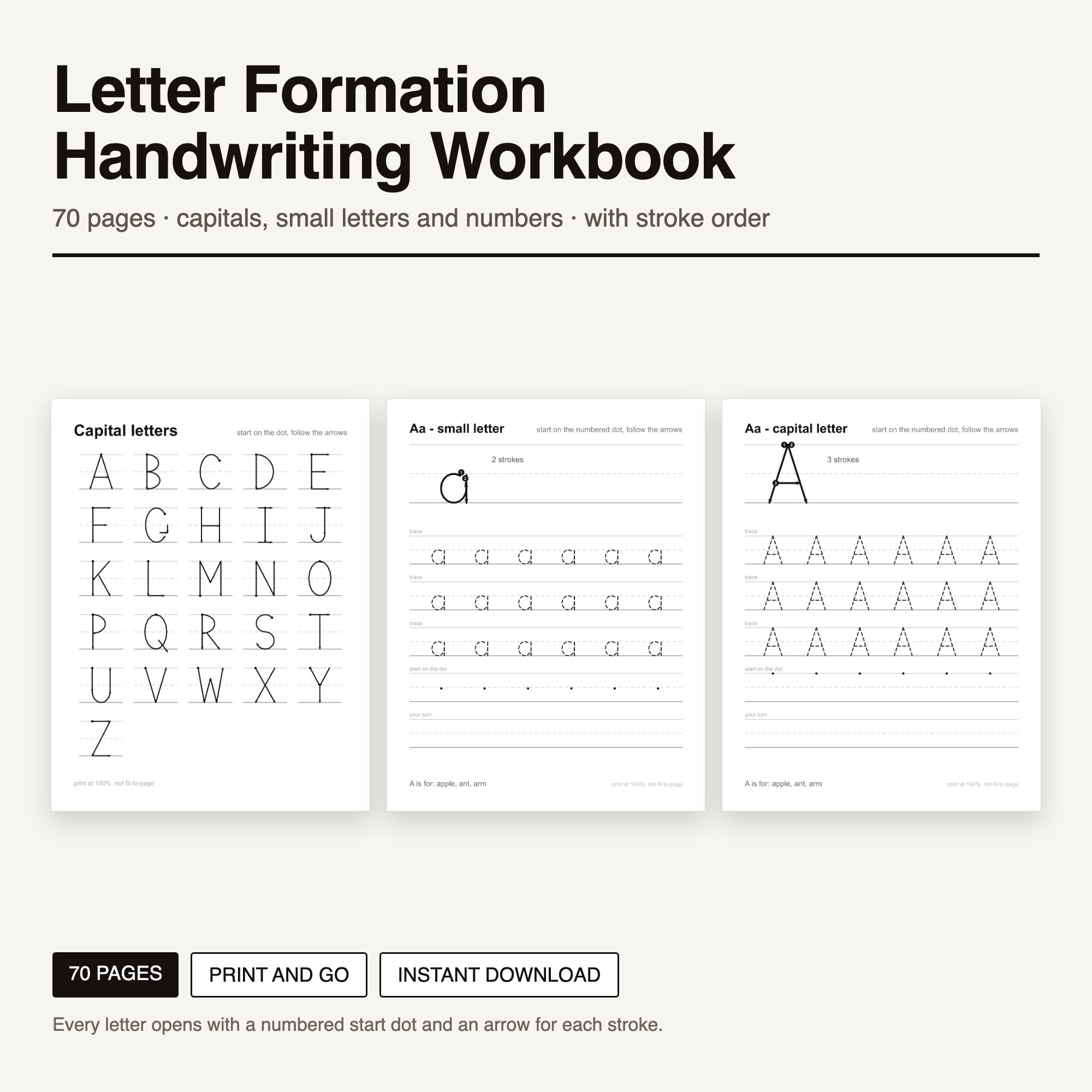
Free printable letter-formation worksheets with arrows
A dotted outline teaches a child to trace a shape. An arrow teaches a child where to start and which way to go — and starting point is the habit that is hardest to unlearn later.
Why the arrow matters more than the outline
A child can trace the outline of a letter perfectly and still be forming it the wrong way — starting at the bottom, building the shape from disconnected pieces, going right to left. None of that shows up in the finished letter on the page; it only shows up later, in speed and legibility, once the letter has to be written from memory. The arrow is the part of the worksheet that actually teaches the habit.
How to use one sheet, not the whole alphabet
One or two letters a sitting, traced slowly with real attention to the starting point, does more than a full page rushed through. Have your child trace the arrow with a finger first, saying the direction out loud, before the pencil touches the page at all.
What to actually watch while they write
Three things: where the pencil lands first, which direction it moves, and whether it lifts and restarts in the wrong place. A child who consistently starts at the bottom of a letter, or who builds a straight-line letter as several disconnected marks, is showing you exactly what to correct — and the arrow sheet is what makes that visible.
Letters that are worth extra attention
Letters that share a starting motion — b, d, p — are the ones most likely to get reversed or confused, because the early motor pattern is nearly identical before the direction diverges. Spend more repetitions here than on a letter like O, which has no wrong starting point to speak of.
What comes after tracing
Once a letter is reliably formed with the arrow as a guide, the next step is the same letter with no arrow at all, then the same letter inside a real word. Skipping straight from arrow-guided tracing to free writing usually brings the old habit straight back.
Questions people ask
Do arrows actually change how a letter looks?
Not immediately, and that is the point — the outline can look identical either way. What the arrow changes is the motor habit underneath it, which shows up later in speed and consistency, not on this one page.
My child already writes letters, just not always correctly. Is it too late for arrow tracing?
No. Arrow tracing is used at any point a habit needs correcting, not only before a child has started writing on their own.
How many letters should one sitting cover?
One or two, done slowly and watched closely, teaches more than a full alphabet rushed through without attention to the starting point.
More like this
Free printable tracing-shapes worksheets for preschoolFree printable tracing-numbers-1-to-10 worksheets for preschoolersPart of our guide to Preschool printables & gifts.