Free printable tracing-shapes worksheets for preschool
Long before a child is ready to trace a letter, they are ready to trace a line and a curve — and shape tracing is where that pencil control actually gets built.
Why shapes come before letters
A letter is really just a small set of lines and curves in a particular order. A child who has not yet practiced a straight line or a controlled curve is being asked to do two things at once when handed a letter worksheet — learn the letter and learn the pencil control. Shape tracing separates the two, and teaches pencil control on its own first.
The order that matches motor difficulty
Straight lines are easiest, followed by simple crosses, then circles, which need a smooth continuous curve, then squares and triangles, which need a corner — the hardest motor skill in the set, because the pencil has to stop, change direction, and start again cleanly. Introduce shapes roughly in that order rather than alphabetically or randomly.
How to use a tracing sheet without it becoming a chore
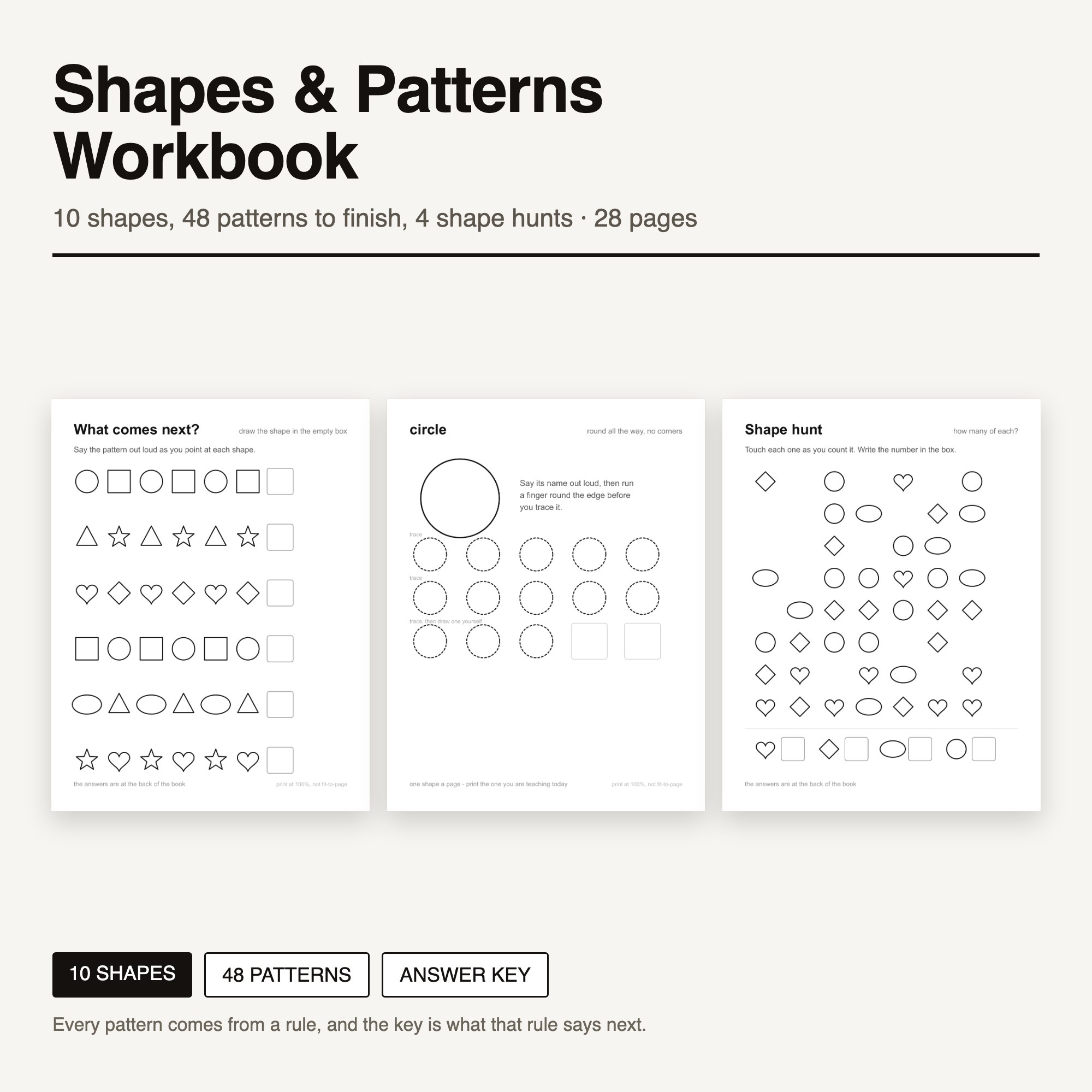
A few shapes at a time, with the finger tracing the shape in the air first, works better than a full page in one sitting. Naming the shape out loud while tracing it links the motor skill to the vocabulary, which is worth as much as the tracing itself at this age.
What good shape control actually looks like
Not a perfect circle — a controlled one. A shaky but continuous line that stays roughly on the path is exactly the skill this practice is building. A child who lifts the pencil constantly or presses hard enough to tear the paper is showing you a grip or pressure issue worth a closer look, not a shape issue.
Where tracing shapes leads next
Once a shape is controlled with a printed line to follow, the next step is the same shape drawn free-hand from a starting dot, then the same shape used inside a real drawing. That is also the direct bridge into letter tracing, since most letters are shape parts recombined.
Questions people ask
What age is shape tracing actually for?
It is most useful in the year or two before a child is ready for letters, though there is no strict age cutoff — it is about pencil control, not age.
My child presses so hard the pencil tears the paper. Is that a shape problem?
Usually a grip or pressure problem rather than a shape problem. A pencil grip and a shorter, thicker pencil often help more than more tracing practice does.
Should shapes and letters be practiced in the same sitting?
Once shapes are reasonably controlled, mixing in a letter or two is fine. Before that, separating them keeps a child from having to solve two problems at once.
More like this
Free printable letter-formation worksheets with arrowsFree printable tracing-numbers-1-to-10 worksheets for preschoolersPart of our guide to Preschool printables & gifts.